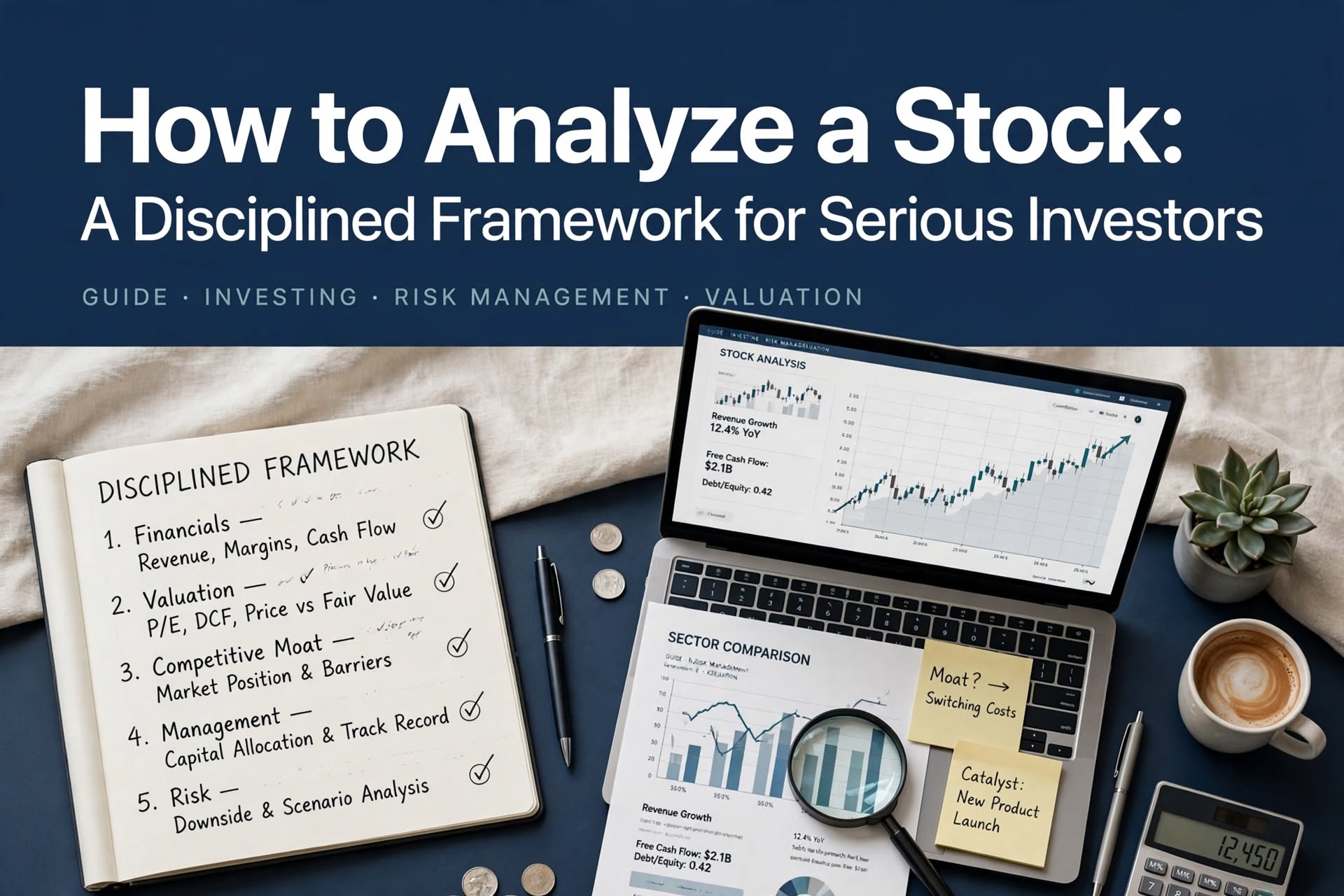
Stock analysis is not a single calculation or a lucky guess. It is a structured process for reducing uncertainty, estimating value, and deciding whether the expected return justifies the risk. Professional investors rarely rely on one metric or one narrative. They combine fundamental research, valuation discipline, technical context, and risk management into a repeatable framework. The following approach provides that structure.
1. Define the Investment Question Before You Open a Spreadsheet
Analysis begins with purpose. Investors must clarify their time horizon, required return, risk tolerance, and the role the stock will play in a portfolio. A three-month trade and a ten-year ownership stake require different evidence and different valuation assumptions. Investors should also stay within their circle of competence. Understanding the business model, revenue drivers, and competitive dynamics is more important than processing every available data point. False precision is a common source of error.
2. Fundamental Analysis: Examine the Business, Not Just the Ticker
Financial statements
Start with the income statement, balance sheet, and cash flow statement. Review at least five years of history and the latest quarterly filings. Key questions include: Is revenue growing organically or through acquisitions? Are gross and operating margins stable or expanding? Does net income convert into free cash flow? Is debt manageable relative to earnings and cash flow? Return on invested capital and return on equity reveal capital efficiency, but they must be interpreted alongside leverage and accounting quality.
Investors should scrutinize footnotes, working capital trends, stock-based compensation, and one-time items. Reported earnings can differ materially from economic earnings. Cash flow usually provides a more reliable view of business quality than headline net income.
Competitive advantage and industry structure
A strong financial record is often the result of a durable competitive advantage. Evaluate market share, pricing power, customer concentration, switching costs, brand strength, and cost advantages. Industry structure matters: cyclicality, regulation, capital intensity, and competitive rivalry all influence long-term returns. A company growing in a structurally declining industry deserves greater skepticism than one growing in a favorable market.
Management and capital allocation
Management quality is difficult to quantify but essential to assess. Review the track record of capital allocation: dividends, buybacks, debt reduction, and acquisitions. Read shareholder letters and proxy statements. Insider ownership and compensation structure can reveal whether management incentives align with long-term owners. Good operators allocate capital rationally; poor operators destroy value even in good businesses.
3. Valuation: Price Is What You Pay, Value Is What You Get
Valuation connects a business assessment to a stock price. Discounted cash flow analysis estimates intrinsic value by projecting free cash flow and discounting it at an appropriate rate. Relative valuation compares multiples such as price-to-earnings, enterprise value-to-EBITDA, and free cash flow yield against peers and historical ranges. No single method is sufficient. Investors should use a range of outcomes and conservative assumptions.
A useful discipline is the reverse discounted cash flow: instead of forecasting value, ask what growth and margin assumptions the current price implies. If those assumptions appear unrealistic, the stock may be overvalued. A margin of safety—buying below estimated intrinsic value—protects against forecasting error. The formula for enterprise value is a useful starting point: Enterprise Value = Market Capitalization + Total Debt - Cash.
4. Technical Analysis: Use Price and Volume as Context
Technical analysis should not replace fundamental research, but it can provide useful context. Price trends, volume patterns, moving averages, support and resistance levels, and relative strength indicate how the market is behaving. These signals can help investors time entries and exits or identify changes in market expectations. However, technical indicators are descriptive, not prophetic. Overfitting indicators to past price data creates false confidence.
5. Qualitative and Macro Factors
Stock analysis must extend beyond the company to the environment in which it operates. Interest rates, inflation, currency movements, regulation, supply chains, and geopolitical risk affect earnings and valuation multiples. Investors should identify potential catalysts—new products, margin recovery, management changes, or industry consolidation—and assess whether those catalysts are already reflected in the price.
6. Risk Analysis: The Part Most Investors Underestimate
Risk is not merely volatility; it is the probability of permanent capital loss. Investors should define position size, diversification, liquidity needs, and thesis invalidation before buying. Scenario analysis—base, bull, and bear cases—helps quantify downside. A clear sell discipline is essential: specify what would cause the thesis to break, not merely what would cause the price to fall.
7. A Practical Stock Analysis Checklist
- Understand the business model and revenue drivers.
- Review five to ten years of financial statements and recent filings.
- Calculate margins, returns on capital, leverage, and cash conversion.
- Assess competitive advantage, industry structure, and management quality.
- Build a valuation range using conservative assumptions.
- Identify catalysts, risks, and what is already priced in.
- Compare expected return with alternatives and required return.
- Define position size and explicit sell criteria.
Good stock analysis is not about being certain. It is about being disciplined, probabilistic, and honest about what is unknown.
Conclusion
Analyzing a stock requires more than reading a screen or following a headline. It demands business understanding, financial rigor, valuation discipline, and risk control. Investors who follow a consistent process—and document their assumptions—are better positioned to distinguish a temporary price decline from a deteriorating business. The goal is not to eliminate uncertainty, but to ensure that the expected reward is adequate for the risk being taken.
Comments
Share your thoughts and join the conversation.
Loading comments...
Please log in to share your thoughts and engage with the community.